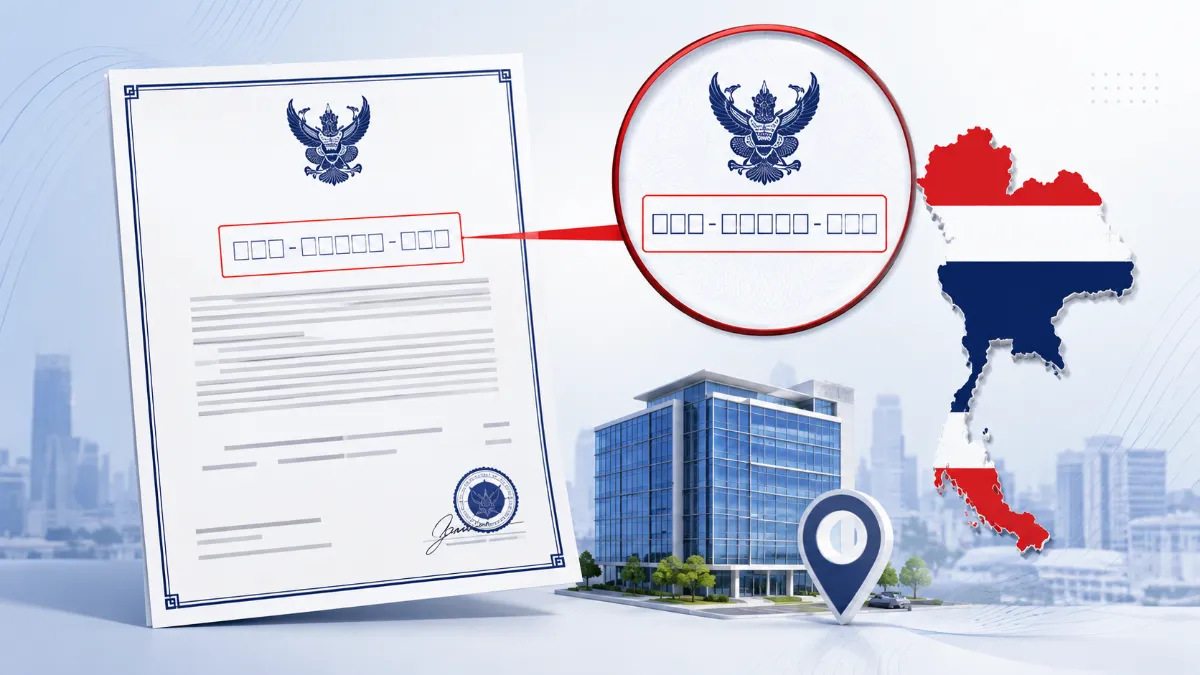
Thailand Business registration number where to find matters whenever you need to verify a Thai company, sign a contract or complete due diligence. Every legally registered entity in Thailand receives a unique 13-digit number from the Ministry of Commerce. Therefore, the quickest approach is to compare the number on official company documents with the record in the Department of Business Development database.
In 2026, the most reliable source remains the official DBD DataWarehouse+ portal. Private corporate-data services can help with language or spelling problems. However, government records should remain the final reference before you make a commercial decision.
- The number contains 13 digits.
- It appears on a Company Affidavit and many tax invoices.
- The DBD DataWarehouse+ portal can show the company’s registered details.
- Always compare private documents with an official registry result.
Thailand Business registration number where to find
The answer to Thailand Business registration number where to find is usually found in three places: the company’s official documents, the DBD DataWarehouse+ portal or a reputable corporate-information provider. First, start with the legal name of the business because brand names may differ from registered names.
A practical verification takes only a few minutes when the company name is known in Thai or English. However, spelling differences, translated names and inactive entities can create confusion. For that reason, treat the registration number as one part of a wider company check rather than as the only proof of reliability.
Which company documents show the number?
The clearest private source is the Company Affidavit, also known as a Certificate of Incorporation. Thai companies receive this legal document through the Department of Business Development. Usually, the unique 13-digit registration number appears prominently near the top of the first page.
Company Affidavit
When you need formal verification, ask the company for a recent copy of its Company Affidavit. Then check whether the registered name, address, directors and registration number match the details used in the contract. If the document shows an old address, request additional clarification before signing.
Tax invoices and receipts
Registered businesses must display their official company name and 13-digit tax identification number on commercial invoices and tax receipts. For Thai registered entities, this tax identification number is identical to the business registration number described in the supplied company information.
Look near the seller’s name or invoice header. If the number on an invoice differs from the number on the Company Affidavit, pause the transaction and request an explanation. This simple check can prevent an avoidable documentation problem.
Letterheads and websites
Some legitimate Thai businesses print registration details in the footer of letters or emails. Others publish them on an About Us page. These sources are useful for a quick cross-check. Nevertheless, they are not as authoritative as a current registry record because website content can become outdated.
For example, a busy procurement officer may receive an invoice within minutes but have no time to review a long company profile. In that situation, checking the 13-digit number against the DBD record before approving the invoice creates a simple second-control step.
How does DBD DataWarehouse+ work?
DBD DataWarehouse+ is the official online business registry maintained by the Department of Business Development under Thailand’s Ministry of Commerce. As a result, users can search for registered businesses and review key public information without relying solely on documents supplied by the company.
Visit the official DBD DataWarehouse+ portal and use the search function. Because the interface may change over time, follow the current instructions shown on the government website when completing a search in 2026.
Search steps
- First, open the official DBD DataWarehouse+ website.
- Next, switch the portal language to English if that option is available.
- Then, enter the company’s full legal name in English or Thai characters.
- After that, review matching records carefully rather than selecting the first result.
- Finally, compare the displayed registration number with the Company Affidavit or invoice.
The search result can show the company’s official 13-digit registration number, active status, registered capital and address. Together, these details help you confirm that the entity name and location correspond with the business you are considering.
Search results can vary when an English name uses a different spelling from the Thai registered name. If the first search fails, try the Thai spelling supplied by the company. Additionally, removing unnecessary punctuation can help locate the correct record.
What should you compare?
A registration number is most useful when several company details agree at the same time. First, compare the number and then check the legal name and address. Registered capital and active status provide additional context. However, neither detail independently guarantees performance or payment.
| Information | Where to check | Why it matters |
|---|---|---|
| 13-digit registration number | Company Affidavit, invoice and DBD portal | Confirms whether the same legal identifier appears across sources |
| Official company name | Legal documents and registry result | Separates the registered entity from a trading brand |
| Address | DBD profile and company paperwork | Shows whether the records relate to the expected business location |
| Active status | DBD profile | Provides an important indication of the entity’s current registry status |
| Registered capital | DBD profile and official extracts | Adds background for basic commercial due diligence |
The strongest basic match is a consistent number combined with the same legal name and address. If only the brand name matches, the evidence is weaker because a brand may be operated by a different registered entity.
When can third-party platforms help?
Third-party corporate-intelligence platforms can be useful when a company is difficult to locate because of language barriers, spelling variations or limited access to Thai documents. For example, services such as OpenCorporates, Aero and local Thai business directories may aggregate publicly available registry information.
These services are convenient for discovery. However, their records may not update at the same time as the government registry. Therefore, use a third-party result to identify a possible match and then confirm the 13-digit number through DBD DataWarehouse+ or an official registry extract.
For a deeper investigation, a corporate-verification agency may obtain official registry extracts from the Ministry of Commerce and prepare an English-language credit or background report. This option can be helpful for overseas buyers who need translated documents or a structured review of several companies.
Source comparison
| Source | Main advantage | Limitation |
|---|---|---|
| Company documents | Fast when you already communicate with the business | Documents may be old or incorrectly supplied |
| DBD DataWarehouse+ | Official government registry source | Searches may require Thai spelling or careful name matching |
| Corporate-data platforms | Helpful for discovery and language support | Aggregated records may not reflect the latest update |
| Verification agencies | Can provide extracts and English reports | Fees and processing requirements vary by provider |
What are the best verification habits?
The most efficient process is a two-source check. First, collect the number from an invoice, Company Affidavit or official email. Next, search the full legal name in DBD DataWarehouse+ and confirm that the same number appears in the government record.
- Record the company’s legal name exactly as shown on the document.
- Save the search date because registry information can change.
- Check both English and Thai spellings when the first search produces no result.
- Compare the address with the contract and invoice.
- Ask for clarification when numbers differ across documents.
- Keep copies of the documents used for the verification record.
For foreign investors, the registration check may sit alongside questions about permitted activities and licensing. In addition, background on the Thailand Foreign Business Act Amendment may help explain why business registration and operating permission are separate issues.
Registration confirms that an entity appears in the business registry. However, it does not automatically prove that the company holds every licence required for its particular activity. If costs are part of your planning, review the information on Foreign business license thailand cost and verify current requirements with the relevant Thai authority.
Common mistakes to avoid
A common mistake is searching only for the company’s popular English brand name. Instead, remember that the legal entity may be registered under a Thai name or a longer formal name. Another error is treating a website footer as final proof without checking the date and the official registry.
- Using a brand name only: Search the full registered name when possible.
- Copying one digit incorrectly: Recheck all 13 digits character by character.
- Accepting an old affidavit: Ask whether the address and directors remain current.
- Relying on an aggregator alone: Confirm the result through DBD DataWarehouse+.
- Confusing registration with licensing: Check activity-specific permissions separately.
If an invoice contains a registration number but the DBD portal shows a different company name, do not assume it is a minor formatting issue. Instead, request an updated document and obtain a clear explanation before making payment or signing a binding agreement.
Frequently asked questions
How many digits does a Thai business registration number have?
A Thai business registration number has 13 digits. Therefore, compare every digit across the Company Affidavit, invoice and official DBD search result.
Is the registration number shown on a Thai tax invoice?
Registered businesses must display their official name and 13-digit tax identification number on commercial invoices and tax receipts. For the entities described here, that number matches the registration number.
Can I search the DBD portal in English?
The DBD DataWarehouse+ portal can be switched to English when that option is available. Meanwhile, Thai-character searches remain useful when an English spelling does not produce a matching result.
What if the company does not appear in the search?
Try the full legal name, remove punctuation and search using the Thai spelling. If no match appears, ask the business for its official Company Affidavit and check the number again.
Are third-party business directories reliable enough?
They can help locate a company when language or spelling creates difficulty. Even so, treat them as discovery tools and confirm the result through the official DBD registry.
Does a registration number prove that a company is trustworthy?
It confirms a registry identity and supports basic due diligence. However, financial reliability, service quality and required operating licences need separate checks.
Should I verify the number before signing a contract?
That is a sensible control, especially for a new supplier or overseas transaction. Before the agreement becomes binding, match the number, legal name and address.
Before relying on the number
Finding a Thailand business registration number is usually straightforward when you combine private paperwork with the official DBD record. In practice, the 13-digit identifier gives you a useful way to confirm the legal entity behind an invoice, website or contract.
For a careful decision, save the documents you checked, note the search date and investigate any mismatch. Before payment or contract signing, verify the latest information through DBD DataWarehouse+ and confirm whether the company needs separate permission for its business activity.