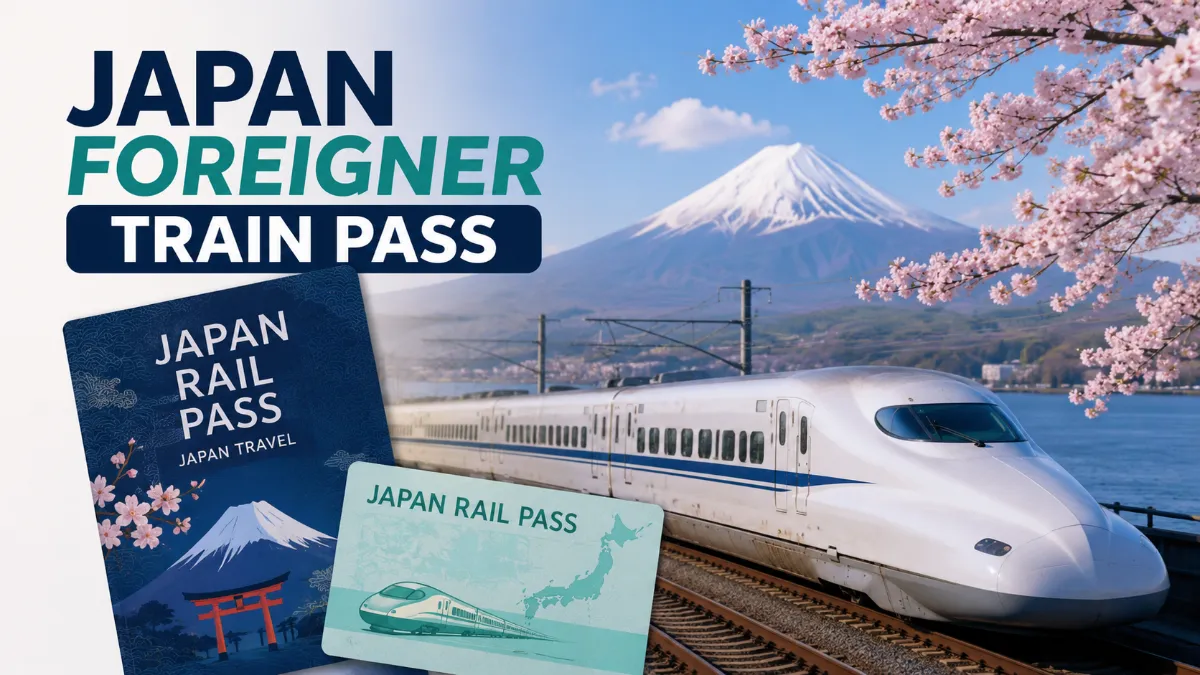
Japan foreigner train pass usually means the Japan Rail Pass, a nationwide ticket for eligible foreign tourists. In practice, it offers unlimited travel on most JR trains for 7, 14 or 21 consecutive days. Therefore, the pass can reduce long-distance travel costs when your route includes several major JR journeys.
In 2026, the ordinary 7-day pass starts at 50,000 yen. However, you must purchase the exchange voucher before entering Japan, then exchange it for the actual pass after arrival. Ultimately, the best value depends on your itinerary, travel dates and use of Shinkansen trains.
What is the Japan foreigner train pass and who can use it?
The Japan foreigner train pass is the Japan Rail Pass, which gives eligible travelers unlimited rides on most JR trains during a selected validity period. In particular, it is designed mainly for foreign tourists entering Japan with a Temporary Visitor stamp.
Visitors may qualify when their passport receives a Temporary Visitor stamp for a 15-day or 90-day stay. Additionally, Japanese citizens who have lived outside Japan continuously for at least 10 years may also qualify, but strict documentary proof is required.
People living in Japan with work, student or other long-term visas cannot use the Japan Rail Pass. In other words, immigration status matters more than nationality alone. Therefore, check your eligibility before paying for an exchange voucher.
Which travelers are usually excluded?
- Residents of Japan with work visas.
- International students holding student visas.
- Long-term residents without Temporary Visitor status.
- Travelers who cannot present the required passport and entry evidence.
For a practical eligibility check, compare your planned entry status with the requirements on the official Japan Rail Pass website. Since rules and purchase procedures can change, official confirmation is safer than relying on an old travel forum.
How much does the Japan Rail Pass cost in 2026?
The Japan Rail Pass costs 50,000 yen for 7 days in Ordinary Class. Meanwhile, longer validity periods cost more, while Green Car passes provide a higher class of seating. Children aged 6 to 11 pay half the applicable adult price.
| Validity | Ordinary Class | Green Car |
|---|---|---|
| 7 consecutive days | 50,000 yen | 70,000 yen |
| 14 consecutive days | 80,000 yen | 100,000 yen |
| 21 consecutive days | 100,000 yen | 130,000 yen |
Children aged 6 to 11 pay half price. However, children under 6 generally travel without a separate pass when they do not require their own reserved seat, although the responsible railway office should confirm the specific arrangement.
Currency conversion varies by country and payment date. For example, a traveler comparing prices in euros, US dollars or Australian dollars should use the current exchange rate instead of an old blog estimate.
When does the Japan foreigner train pass save money?
The pass can save money when several expensive JR journeys fit inside the same 7, 14 or 21 consecutive-day period. By contrast, a single Tokyo trip rarely justifies the pass because local fares alone may not approach the 7-day price.
Consider a gradual itinerary rather than an ambitious one. For example, a traveler starting in Tokyo then visiting Kyoto and Hiroshima before returning to Tokyo may benefit from a nationwide pass. However, a Tokyo-only holiday with one short regional trip may offer weaker value.
The key budget test is simple: add the normal JR fares for your planned long-distance journeys and compare the total with the pass price. Importantly, include only routes the pass actually covers. Private railways, city subways and many non-JR services require separate payment.
Seven practical budget tips
- Map the expensive journeys first. In particular, focus on intercity Shinkansen and limited express travel.
- Match the validity window. Remember that the 7-day pass covers consecutive days, not seven separate travel days.
- Start activation strategically. Choose the first active day when your costly JR travel begins.
- Compare Ordinary and Green Car. Green Car is more comfortable, but it adds 20,000 yen to the 7-day adult price.
- Check regional alternatives. A regional rail pass may suit a smaller route better than a nationwide ticket.
- Reserve popular trains early. Seat reservations are free through JR ticket machines or designated counters.
- Keep non-JR transport separate. Therefore, budget separately for Tokyo Metro, many private railways and local buses.
These steps reveal an often-missed point: the pass is a timing product as much as a transport product. For instance, a 14-day pass may be wasteful if your major JR journeys occur within only one compact week.
Which trains and services are included?
The Japan Rail Pass includes most JR Shinkansen services such as Hikari, Sakura and Kodama. It also covers JR local trains, limited express trains, the Tokyo Monorail and the JR ferry to Miyajima.
However, top-speed Nozomi and Mizuho bullet trains require an additional supplemental ticket. The Japan Rail Pass itself does not automatically provide unlimited access to those services. Consequently, travelers should ask a JR office about the correct supplement before boarding.
| Service | Pass treatment | Budget implication |
|---|---|---|
| Hikari, Sakura and Kodama Shinkansen | Included on eligible routes | No separate basic fare for covered travel |
| Nozomi and Mizuho | Supplemental ticket required | Extra cost applies |
| JR local and limited express trains | Generally included | Useful for city and regional connections |
| Tokyo Monorail and JR ferry to Miyajima | Included for eligible services | Helpful for airport or island connections |
| Private railways and city subways | Usually not included | Budget for separate tickets or cards |
Route coverage can contain exceptions. For example, a station may be served by both JR and a private operator, yet the pass will not cover the private train. Therefore, check the operator name on your route before entering the station.
How do you buy and activate the Japan foreigner train pass?
To buy the Japan Rail Pass, order an exchange voucher online through the official JR website or an authorized agent before traveling to Japan. After arrival, exchange the voucher at a designated JR counter.
- Purchase the exchange voucher before entering Japan.
- Carry the physical passport used for the purchase.
- Present the passport and exchange voucher at a designated JR counter.
- Receive the actual Japan Rail Pass and select the activation date.
- Use automatic ticket gates or show the pass to station staff.
Major stations and airports provide designated exchange locations. Therefore, keep the physical documents accessible in your hand luggage. A digital passport image or a photocopy may not meet the exchange requirement.
Seat reservations are available at JR ticket machines or JR counters without a separate reservation fee. During busy travel periods, reserve seats soon after deciding your route, especially when several people travel together.
What are the main advantages and limitations?
The strongest advantage is predictable access to a broad JR network. On the other hand, the main limitation is its high upfront price and restricted coverage outside JR services. As a result, a careful comparison prevents the pass from becoming an expensive convenience purchase.
Advantages
- Unlimited rides on most eligible JR trains during the chosen period.
- Access to major Shinkansen routes served by Hikari, Sakura and Kodama.
- Free seat reservations through JR machines or counters.
- Useful coverage for the Tokyo, Kyoto, Osaka and Hiroshima travel corridor.
- One pass can simplify planning across multiple regions.
Limitations
- The 7-day ordinary pass starts at 50,000 yen.
- Nozomi and Mizuho require a supplemental ticket.
- Private railways and many city subways are excluded.
- The validity period runs on consecutive days.
- Eligibility depends on immigration status and supporting documents.
For instance, a visitor staying mainly in Kyoto may spend less by using local transport and occasional regional tickets. By contrast, someone crossing several regions can gain more from nationwide coverage.
What common mistakes make the pass poor value?
Most poor-value purchases happen when travelers buy the Japan Rail Pass before calculating their actual JR routes. In fact, the pass is not automatically cheaper simply because a trip includes Japan, Shinkansen or several cities.
- Buying for local sightseeing: City subway rides are often outside JR coverage.
- Ignoring consecutive days: Unused days still count once the pass becomes active.
- Assuming every bullet train is included: Nozomi and Mizuho need a supplemental ticket.
- Forgetting the physical passport: The exchange counter requires the qualifying document.
- Using the wrong visa category: Work and student visa holders cannot use the pass.
- Skipping reservation planning: Free reservations do not guarantee a seat during busy periods.
Travelers researching life beyond tourism may also find related information useful, such as Japan Foreigner Jobs or Japan foreign relations. Nevertheless, those topics are separate from rail-pass eligibility.
What expert budget checks should you complete?
A reliable budget check combines route coverage, validity dates and transport alternatives. First, write down every long-distance journey, identify the operating company and compare the total fare with the pass price.
- Confirm whether each train is operated by JR.
- Mark the first and last expensive travel days.
- Compare the 7-day, 14-day and 21-day prices.
- Separate airport, subway and private railway costs.
- Check the current official rules before ordering.
Accommodation planning can affect the rail decision too. Visitors considering a longer stay may read about Buying Property Japan Foreigner or Buy House Japan Foreigner, but property status does not create Japan Rail Pass eligibility.
Japan foreigner train pass FAQ: what do travelers ask?
Can I buy the Japan Rail Pass after entering Japan?
The exchange voucher must be purchased before entering Japan under the stated purchase process. After arrival, you exchange that voucher at a designated JR counter for the actual pass.
Can people living in Japan use the Japan Rail Pass?
People living in Japan with work, student or long-term visas cannot use the pass. Instead, eligibility is intended mainly for foreign tourists holding Temporary Visitor status.
How long is a Japan Rail Pass valid?
The available validity periods are 7, 14 or 21 consecutive days. The days run continuously after the selected activation date rather than functioning as a flexible day-pass allowance.
Are Nozomi and Mizuho included?
Nozomi and Mizuho require an extra supplemental ticket. Meanwhile, Hikari, Sakura and Kodama are the main listed Shinkansen services included under the pass.
Can children use the Japan Rail Pass?
Children aged 6 to 11 pay half price. Therefore, families should confirm the current child conditions with the official JR sales channel before purchase.
Can I reserve seats for free?
Yes. Pass holders can make seat reservations at JR ticket machines or JR counters without a separate reservation charge, subject to available seats.
Does the pass cover Tokyo subway trains?
The pass covers eligible JR services such as the Tokyo Monorail, but it does not generally cover Tokyo Metro or other private subway operators. Consequently, separate local transport costs may apply.
Is the Japan Rail Pass right for your 2026 itinerary?
The Japan Rail Pass is most suitable for eligible foreign tourists taking several costly JR journeys within one consecutive validity period. Since its 50,000-yen 7-day ordinary price is substantial, route planning is essential.
Before ordering, confirm your Temporary Visitor status, compare the full JR fare total and identify services that need supplemental tickets. When the numbers support it, the pass offers simple nationwide travel. Otherwise, ordinary tickets or a regional option may be the more sensible budget choice.