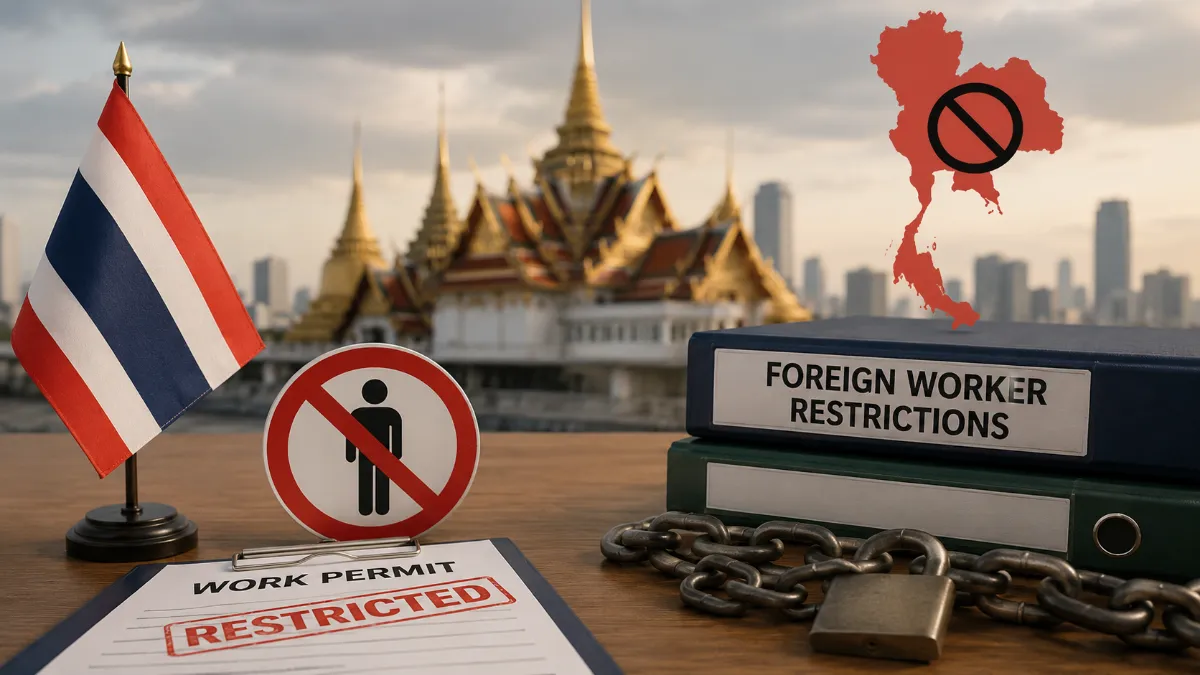
Thailand foreign worker restrictions can affect anyone who performs paid or unpaid work inside the country. In practice, the main controls include 40 protected occupations, a personal work permit linked to one employer, minimum company capital, and local-to-foreign staffing requirements. Some jobs are completely prohibited. Consequently, violations may result in fines of THB 5,000 to THB 100,000, imprisonment, and deportation.
The difficult part is that Thai law uses a broad definition of work. In particular, physical and mental activities may count, even when no salary is paid. Therefore, a foreign visitor, volunteer, remote freelancer, or business owner should confirm authorization before starting any activity in Thailand during 2026.
What are Thailand foreign worker restrictions?
Thailand foreign worker restrictions are legal limits on the occupations, employers, locations, and activities available to foreign nationals in Thailand. In effect, they combine prohibited-job rules with work-permit conditions and employer eligibility requirements. A person can therefore face a problem because of the job itself or because the permit does not match the actual work.
Thailand’s Department of Employment administers the work-permit system. For that reason, its official information should be checked before employment begins, especially when a job title involves sales, tourism, transport, services, manual tasks, or professional advice. The Department of Employment is the most appropriate starting point for current government guidance.
Which occupations are completely prohibited for foreigners?
Foreigners cannot perform 27 entirely off-limits occupations under the restrictions described in the supplied legal summaries. However, these occupations are different from jobs that may be available under narrow conditions. Therefore, a work permit does not make a completely prohibited occupation lawful.
- Traditional Thai massage and spa therapy services
- Driving motor vehicles or taxis, except operating factory forklifts
- Retail sales, street vending, and hawking
- Hairdressing, beauty services, and nail services
- Tour guiding and local travel organizing
- Legal and litigation services
- Manual labor, subject to narrow exceptions for workers from neighboring countries covered by official memoranda of understanding
- Craft work such as wood carving, silversmithing, and hand-weaving
The practical risk is job substitution. For example, a foreign manager may legally oversee a salon but may not personally provide hairdressing or nail services if that activity falls within a prohibited occupation. Similarly, a foreign hotel employee may coordinate operations but cannot assume that guiding visitors through local attractions is permitted.
Why does the 27-job list matter?
The list matters because it creates a first-stage screening test. If the real task matches a prohibited occupation, changing the job title will not solve the issue. Instead, a company should compare the daily duties with the restricted occupation rather than relying only on a contract label.
Craft production illustrates the problem clearly. For instance, a foreign national who designs a product may have a different role from a person who physically performs hand-weaving or wood carving. However, the exact duties and legal classification should be confirmed with the Department of Employment before work starts.
What are the 40 protected occupations?
The 40 protected occupations are broader than the 27 completely prohibited jobs. In other words, they represent work areas reserved for Thai nationals or controlled through specific exceptions. Some occupations may have limited pathways for eligible foreign workers, while others remain unavailable in ordinary circumstances.
This distinction is useful for long-term planning. A protected occupation is not automatically the same as a completely banned occupation. Nevertheless, a foreign worker should not assume that an exception exists without checking its conditions, nationality requirements, employer documents, and permit wording.
For a proposed job, review four details:
- The actual daily duties rather than the job title alone
- Whether the occupation appears on a prohibited or protected list
- Whether a nationality-based exception or MOU pathway applies
- Whether the employer and work-permit conditions support the role
A neighboring-country worker entering through an official MOU arrangement may face a different legal route for certain manual tasks. Even so, that exception does not create a general entitlement for every foreign national. In practice, nationality and recruitment channel can change the answer.
What employer capital and staffing rules apply?
A company hiring foreign nationals generally needs at least THB 2,000,000 in registered capital for the first foreign employee. Furthermore, each additional foreign hire requires another THB 2,000,000 in registered capital under the supplied employer rules. The Department of Employment also manages local-to-foreign staffing requirements.
| Employer issue | Stated requirement | Why it matters |
|---|---|---|
| First foreign employee | At least THB 2,000,000 in registered capital | The company must meet the financial threshold before supporting the hire |
| Each additional foreign employee | Another THB 2,000,000 in registered capital | Hiring more foreign staff increases the required capital |
| Local-to-foreign staffing | Official staffing ratios may apply | The company may need an appropriate number of Thai employees |
| Work-permit scope | One employer, one location, and one exact job description | Work outside the approved scope can create a violation |
Consider a company planning to employ three foreign workers. On the supplied figures, it would need THB 6,000,000 in registered capital before considering other requirements. However, that calculation does not replace an official review because company structure, permits, nationality, and current administrative practice may affect eligibility.
Do staffing ratios work like a simple formula?
Not always. Although local-to-foreign hiring ratios are part of the employer assessment, the relevant calculation may depend on the company’s records and the application type. As a result, a business should not rely on capital alone. Thai employee numbers, payroll records, tax documents, and corporate registration details may also matter.
Before recruitment, an employer can prepare a compliance file containing its registration documents, capital information, Thai staffing records, proposed job descriptions, and workplace details. This approach reduces delays because the permit application can be checked against the real business structure.
Why must a work permit match one employer and one location?
A Thai work permit is strictly personal and is tied to one employer, one location, and one exact job description. In contrast, it is not a general license to work for any business in Thailand. A change of employer, workplace, or material duties may require a new application or formal permission.
For example, a foreign marketing employee assigned to a Bangkok office should not assume the same permit covers regular work at a separate branch in Chiang Mai. Likewise, a permit for administrative work may not cover hands-on retail sales, technical installation, or customer-facing tour services.
Keeping the permit and the actual role aligned is one of the simplest ways to reduce risk. Employers should also record changes before they occur instead of treating a later correction as automatic approval.
Foreign employees who need a clearer overview of digital applications can review the Thailand foreign e workpermit system. Although the online process may improve convenience, it does not remove occupation restrictions or employer eligibility rules.
Does unpaid or remote work require authorization?
Thai law defines work broadly as physical or mental activity, whether paid or unpaid. As a result, unpaid volunteer tasks, charity teaching, and remote digital freelance work performed inside Thailand may still require authorization. Therefore, the absence of salary is not a reliable test.
Imagine a foreign visitor who teaches English at a charity for two weeks without receiving payment. Even so, the activity may still be treated as work because teaching involves organized mental activity carried out inside Thailand. Similarly, a remote designer working for an overseas client also should not assume that location is irrelevant.
The correct question is not only “Who pays me?” Instead, it is also “What activity am I performing, where am I performing it, and what authorization covers it?” Immigration status, work authorization, tax treatment, and occupational rules can involve separate questions.
How should digital nomads assess their position?
Digital nomads should document the activity, client relationship, work location, and visa status before working from Thailand. They should then seek current guidance from the relevant Thai authorities or a qualified adviser. Since rules can change, an overseas client does not automatically remove Thai work-permit considerations.
What penalties can follow a violation?
Violating Thailand foreign worker restrictions can lead to fines ranging from THB 5,000 to THB 100,000. Depending on the circumstances, consequences may also include imprisonment and deportation. In each case, the exact outcome depends on the offense, the person’s status, the employer’s conduct, and enforcement decisions.
A company can face separate exposure from the individual worker. Therefore, employers should not treat compliance as the worker’s personal responsibility. In most cases, a written role review before recruitment is less costly than correcting an unauthorized assignment after an inspection.
These figures should be treated as a compliance warning rather than a complete penalty schedule. Anyone facing an investigation, arrest, permit cancellation, or deportation risk should obtain qualified legal assistance and consult official Thai authorities promptly.
Which practical checks help employers and workers?
The strongest compliance process starts before the first working day. It compares the proposed duties with the occupation rules and checks whether the employer can support the application. In particular, small wording differences can matter when the permit is restricted to an exact job description.
Expert tips for a safer application
- Write a duty list using plain, specific verbs such as “manage,” “analyze,” or “supervise.”
- Separate managerial oversight from hands-on tasks that may be protected.
- Confirm the work location before submitting the permit application.
- Check capital and Thai staffing records against the number of foreign hires.
- Keep copies of the permit, employment contract, company documents, and official correspondence.
- Recheck authorization before adding a branch, changing duties, or accepting volunteer work.
A useful internal test is the “three-way match”: the contract, the permit, and the worker’s daily activities should describe the same role. If one document says office administration while the worker spends most days selling products, the mismatch deserves immediate review.
Common mistakes to avoid
- Assuming unpaid work is automatically exempt
- Using a broad job title to hide restricted duties
- Working at a second location without checking permit coverage
- Changing employers before obtaining the required approval
- Counting registered capital without reviewing staffing requirements
- Relying on a social-media post instead of current government guidance
These mistakes often arise from informal arrangements. For example, a foreign worker may help a friend’s shop for a single afternoon or assist at a community event. Because Thai law can define work broadly, casual intent does not necessarily remove the authorization issue.
What should a foreign worker do before starting a job?
Before starting, identify the exact employer, workplace, duties, and compensation arrangement. Then check the occupation lists and confirm that the employer meets the capital and staffing requirements. Finally, verify that the work permit or other authorization covers the activity before performing it.
- Obtain the written job description.
- Compare each duty with the protected and prohibited occupation rules.
- Ask the employer how the capital and Thai staffing requirements are satisfied.
- Confirm the approved employer and work location.
- Keep the permit details available while working.
- Seek official clarification when the activity is unpaid, remote, volunteer-based, or mixed with another role.
Long-term planning is especially important for entrepreneurs and digital professionals. For instance, a role that appears acceptable during a short visit may become a compliance issue when it turns into regular business activity. Checking early protects both the worker and the company.
Frequently asked questions about Thailand foreign worker restrictions
Can a foreigner work in Thailand without receiving a salary?
Not necessarily. Thai law defines work broadly and may include unpaid physical or mental activity. Therefore, volunteer tasks, charity teaching, and similar activities can require authorization even when no salary is paid.
Can a work permit cover two Thai employers?
The stated rules tie a work permit to one exact employer. Consequently, a second employer generally requires separate approval or a new permit arrangement. Do not begin the additional work before checking the current requirements.
Can a foreign employee work at another branch?
A permit is tied to one specific location. As a result, work at another branch may fall outside the approved scope. The employer should confirm the location requirement before assigning the employee elsewhere.
How much registered capital is required for one foreign worker?
The supplied employer rule states that at least THB 2,000,000 in registered capital is required for the first foreign employee. Under that rule, additional foreign hires require another THB 2,000,000 each.
Is driving a taxi allowed for foreigners in Thailand?
Driving motor vehicles or taxis is listed among the completely prohibited occupations described in the supplied information. However, operating a factory forklift is identified as a narrow exception.
Can foreigners provide Thai massage or spa therapy?
Traditional Thai massage and spa therapies are included in the completely prohibited occupation list provided for this article. Therefore, a foreigner should not assume that a work permit overrides that restriction.
What can happen after an unauthorized work violation?
Possible consequences include fines from THB 5,000 to THB 100,000. In addition, imprisonment and deportation may also apply depending on the circumstances and enforcement action.
Where can current work-permit information be checked?
Start with Thailand’s Department of Employment and verify the current requirements for the exact occupation, employer, location, and nationality. In particular, rules and administrative procedures should be checked again before filing an application in 2026.
Conclusion
Thailand foreign worker restrictions are easiest to manage when the real duties are reviewed before work begins. First, check the 27 completely prohibited occupations, the wider list of 40 protected occupations, employer capital, Thai staffing, and the permit’s exact scope.
Do not rely on an unpaid status, a remote client, or a flexible job title as proof of exemption. For a long-term stay, keep the contract, permit, workplace, and daily activities aligned. When facts are uncertain, obtain current guidance from the Department of Employment or a qualified Thai legal professional.