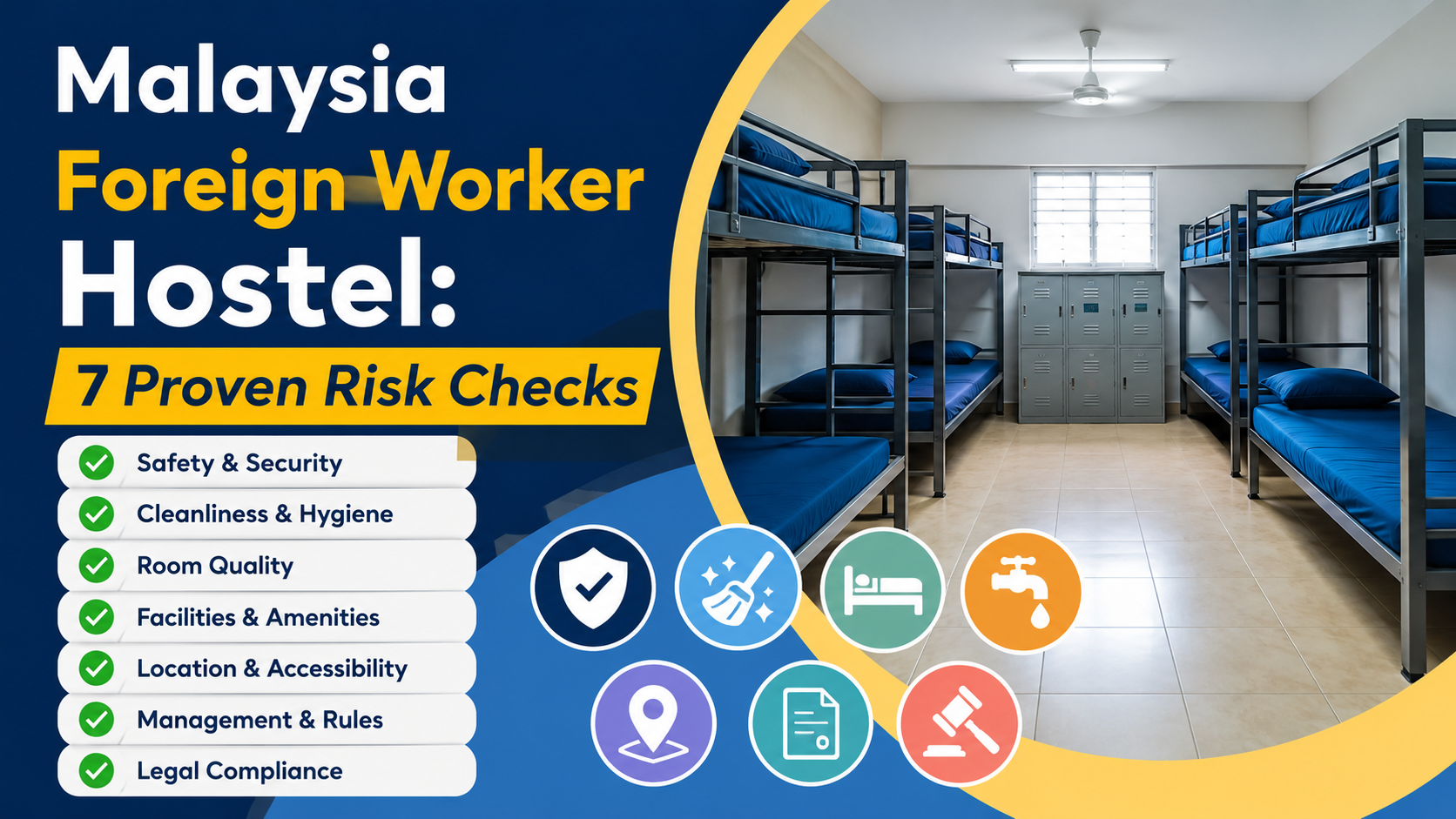
Malaysia foreign worker hostel selection is an Act 446 compliance decision, not simply a search for the lowest rent. Employers should verify the Certificate of Accommodation, approved occupancy, fire safety, hygiene, documentation, worker welfare and transport before moving workers in. A clean-looking room can still create serious risk if the actual bed count does not match the approved records.
Under the Workers’ Minimum Standards of Housing, Accommodations and Amenities Act 1990, employers and hostel operators must provide accommodation that meets legal and practical standards. Purpose-built Centralized Labour Quarters (CLQs), managed dormitories and approved in-house conversions can all be suitable when the premises, capacity and management systems are properly approved.
How should employers choose a Malaysia foreign worker hostel?
The best Malaysia foreign worker hostel is legally approved, physically safe, properly managed and suitable for long-term workforce stability. Employers should compare the hostel’s documents with its real condition instead of relying only on price, location or a short viewing.
A practical screening process should confirm whether the accommodation has a valid Certificate of Accommodation (COA), controlled occupancy, suitable beds, safe exits, clean shared facilities, maintenance records and a responsible management team. These checks reduce the risk of failed inspections, worker relocation and client audit rejection.
- Valid COA issued through the relevant Department of Labour Peninsular Malaysia process
- Approved occupancy capacity that matches the actual number of residents
- Fixed beds, adequate ventilation and no unauthorised partitions
- Fire extinguishers, clear emergency exits and evacuation procedures
- Clean toilets, bathrooms, rest areas and waste facilities
- Cleaning, maintenance and pest control records
- A warden, complaint channel and practical worker support system
- Safe transport access to the workplace
Read More Post: malaysia foreign universities
What does Act 446 require from a Malaysia foreign worker hostel?
Act 446 requires employers or accommodation operators to meet minimum standards for housing, amenities and safety. A valid COA is a central part of the approval process, so employers should verify the certificate status and confirm that it covers the actual premises and approved capacity.
Employers can review official information from the Department of Labour Peninsular Malaysia on Act 446. Requirements and administrative procedures can change, so the latest official guidance should be checked before signing a lease or relocating workers.
Which documents should be checked first?
The first document review should cover the COA, approved occupancy details and accommodation records. The worker list, room allocation and physical bed count should tell the same story. If the records show 100 residents but the rooms contain additional unrecorded beds, the accommodation may face a compliance problem even if the building appears tidy.
Employers managing their own property must still obtain the required local council and JTKSM approvals. Converting an ordinary residential unit without checking its suitability can create legal, safety and operational exposure.
How can employers prevent overcrowding and poor room conditions?
Employers should inspect the real room layout rather than accepting a floor plan or verbal occupancy estimate. Each worker needs an approved sleeping space with a proper fixed bed, adequate airflow, suitable lighting and enough room to move safely.
During an inspection, count the beds in every room. Check whether mattresses are usable, lockers are available and windows or ventilation systems provide reasonable airflow. Hidden beds, makeshift sleeping areas, illegal partitions and blocked walkways are warning signs.
Male and female workers must have separate accommodation facilities and quarters where required. Segregation should be reflected in the room allocation records and in the physical arrangement of the premises. A hostel that mixes records or uses temporary arrangements can become difficult to manage during an inspection.
| Area | What a responsible employer should verify |
|---|---|
| Occupancy | Actual residents match the approved capacity |
| Sleeping arrangement | Fixed beds are properly positioned with no hidden sleeping spaces |
| Ventilation | Rooms have usable airflow and are not sealed or overcrowded |
| Layout | Walkways remain clear and the physical layout matches approved records |
| Segregation | Male and female quarters are arranged separately where required |
What safety features should a Malaysia foreign worker hostel have?
A safe hostel should have visible and usable fire equipment, clear exits, emergency access and an evacuation plan. Safety should not exist only in a file prepared for an audit.
Inspectors and employers should check fire extinguishers, electrical connections, emergency routes, first-aid readiness and access to assembly areas. Expired equipment, blocked exits or overloaded electrical points require immediate attention.
For larger worker groups, a structured response system can include a trained Emergency Response Team and first-aid support. Some managed accommodation arrangements also provide health services, a quarantine room or an in-house clinic. These facilities do not replace legal approval, but they can strengthen worker welfare and daily incident management.
Why are daily management records important?
Daily records show whether safety controls work after workers move in. A hostel operator should be able to explain who checks emergency equipment, how defects are reported and how quickly repairs are completed. A maintenance log with no evidence of corrective action is weak protection during a real incident.
How should employers assess hygiene and maintenance?
Hygiene depends on daily systems rather than the condition seen during one scheduled visit. Employers should inspect toilets, bathrooms, kitchens, waste areas, common rooms and pest-control arrangements while reviewing the cleaning schedule and maintenance reports.
Auditors may compare the written cleaning log with the physical condition of the hostel. If records show daily cleaning but toilets are poorly maintained or waste is accumulating, the documentation will not support the employer’s position. The same principle applies to pest control and repair requests.
- Review cleaning responsibilities for each shared area
- Confirm the frequency of waste collection
- Check pest-control treatment records and follow-up actions
- Inspect water, lighting and ventilation in bathrooms
- Record damaged beds, doors, electrical points and plumbing fixtures
- Keep corrective action records until each issue is closed
What makes a hostel audit-ready and worker-friendly?
An audit-ready hostel keeps its records current and consistent with the actual site. A complete file may include the COA, worker lists, room allocation, safety checks, cleaning logs, maintenance reports and corrective action records.
Worker welfare also affects retention, discipline and attendance. Clear house rules, a complaint channel, reasonable visitor controls and proper supervision help workers understand the accommodation arrangements. Workers should be able to raise genuine concerns without feeling that complaints will be ignored.
A warden or responsible site manager is particularly useful when many workers share one facility. The manager can monitor occupancy, report defects, coordinate cleaning and respond to urgent issues. Outsourced CLQ management can provide greater consistency for employers that do not have an internal accommodation team.
How do location and transport affect hostel value?
Location affects more than rental cost. A hostel that is far from the workplace may increase travel time, fatigue, lateness and transport risk. Employers should assess shift patterns, road access, vehicle capacity and the reliability of the daily route.
For example, a lower-cost hostel can become expensive when workers need long daily transfers or when transport arrangements cannot support multiple shifts. Accommodation near an industrial area may make workforce planning easier, but the premises must still meet Act 446 and local approval requirements.
Which accommodation model suits different employers?
Employers generally consider large-scale dormitories, managed CLQs or in-house property conversions. The right model depends on headcount, workplace location, management capacity and the level of compliance support required.
| Accommodation model | Potential advantage | Key point to verify |
|---|---|---|
| Large-scale managed dormitory | Structured facilities with established site operations | COA coverage, occupancy and transport arrangements |
| Centralized Labour Quarters | Purpose-built housing designed for organised worker accommodation | JTKSM approvals, safety systems and management quality |
| In-house conversion | May use an employer-controlled property | Local council approval, JTKSM approval and inspection readiness |
Operators such as Westlite Accommodation manage large facilities across locations including Johor, Penang and Selangor. Regional providers and local operators such as Elite Quarters may also support site operations, transport logistics and compliance renewal work. Employers should verify current approvals, scope of service and site-specific capacity directly with each provider.
What are the most common hostel selection mistakes?
The most common mistake is choosing accommodation only because it is cheap or close to the workplace. The apparent saving can disappear after failed inspections, urgent relocation, worker complaints, client audit issues or repeated maintenance problems.
- Choosing a hostel based only on monthly rental cost
- Using non-approved residential units without checking suitability
- Ignoring the COA or failing to verify its current status
- Assuming a clean viewing means the premises are fully compliant
- Overlooking fire equipment, blocked exits or electrical risks
- Accepting weak or incomplete occupancy records
- Skipping a physical inspection before signing an agreement
- Ignoring worker complaint and supervision systems
- Selecting accommodation without a transport plan
The most dangerous situation is accommodation that is paper compliant but physically non-compliant. Employers should inspect both sides of the issue: the documents must be valid and the rooms, beds, exits, toilets and management systems must match those documents.
How should employers compare cost with long-term value?
The best Malaysia foreign worker hostel is not necessarily the cheapest option. A proper comparison includes rent, transport, maintenance, inspection risk, worker relocation, client audits and productivity disruption.
A professionally managed facility may offer better long-term value when it provides stable housing, controlled occupancy, faster maintenance response, safer shared areas and stronger documentation. This does not mean every managed provider is automatically suitable. Employers should still conduct due diligence and confirm the approval status of the specific site.
LG Solution (M) Sdn Bhd, also known as Elite Quarters, is presented in the supplied information as a provider combining accommodation, documentation, safety monitoring, hygiene checks, maintenance coordination, worker support and audit preparation. Employers considering this or another provider should verify the current service scope, COA status, capacity and contract responsibilities before making a decision.
What should employers check before signing a hostel agreement?
Before signing, employers should complete a document review, physical inspection and management assessment. The following sequence keeps the decision practical.
- Request the COA and confirm that it relates to the actual premises.
- Compare approved capacity with the intended worker headcount.
- Inspect every room, including beds, ventilation, lockers and walkways.
- Check fire equipment, exits, evacuation information and first-aid readiness.
- Review cleaning, pest-control, maintenance and corrective action records.
- Confirm male and female accommodation arrangements where applicable.
- Ask who manages complaints, visitors, repairs and emergency response.
- Test the transport plan against shift times and vehicle capacity.
- Record agreed responsibilities in the accommodation contract.
What are the key questions employers ask about a Malaysia foreign worker hostel?
What is the most important document for a foreign worker hostel in Malaysia?
The Certificate of Accommodation is one of the most important documents. Employers should verify its validity, premises details and approved occupancy through the relevant JTKSM process. The actual hostel condition must also match the approved records.
Can employers convert their own property into a worker hostel?
They may consider an in-house conversion, but the property must meet the applicable Act 446 requirements and obtain the required local council and JTKSM approvals. Using an employer-owned building does not remove the need for inspection or certification.
How can employers identify overcrowding?
Count the residents and fixed beds in every room then compare the result with the approved capacity. Illegal partitions, hidden beds, blocked walkways and poor ventilation are practical warning signs.
Are managed CLQs better than ordinary rented housing?
A managed CLQ can offer stronger site control, documentation and daily maintenance, but quality depends on the specific operator and facility. Employers should verify COA status, occupancy, safety systems, hygiene and transport before choosing.
What should a hostel inspection include?
It should include documents, room capacity, bed arrangements, ventilation, fire safety, toilets, bathrooms, waste areas, pest control, maintenance records, worker welfare systems and transport access.
Why is transport part of hostel selection?
Transport affects attendance, fatigue, safety and shift planning. A distant hostel may create hidden costs through late arrivals, unreliable transfers and additional vehicle requirements.
Is the cheapest foreign worker hostel the best choice?
Not usually. Employers should compare total value rather than rent alone. Inspection failure, relocation, poor maintenance and client audit rejection can cost more than the initial rental saving.
Conclusion
Choosing a Malaysia foreign worker hostel requires more than comparing price and distance. Employers should verify Act 446 readiness, COA status, occupancy, room conditions, fire safety, hygiene, documentation, worker welfare and transport before workers move in.
Large dormitory operators, managed CLQs and in-house conversions can all work when approvals and daily controls are in place. For medium-sized and larger workforces, a structured provider may help maintain consistent records, safety checks and worker support. The safest decision is the one that remains compliant and manageable after occupancy begins.